
Père Marquette Caboose, No. A967

Holland Museum Père Marquette
Restoration Project: Phase-1 Complete!
The first phase of the Holland Museum Père Marquette Restoration project is complete and we owe its success to the incredible generosity of many people whose steadfast support and belief in this project brought about such outstanding results. This includes the contributions of sponsors, individual donors, the Holland Museum Staff and Board of Directors, Exhibitions and Collections committees, and 2021 Summer Interns. We appreciate the valuable assistance received from Fritz Milhaupt and the Pere Marquette Historical Society and special recognition and thanks to Clare Heyboer, Caboose Restoration Project Manager, who gave hours of his time, expertise, and resources.
Learn more about how you can support the Père Marquette Caboose restoration project.
Before exterior restoration

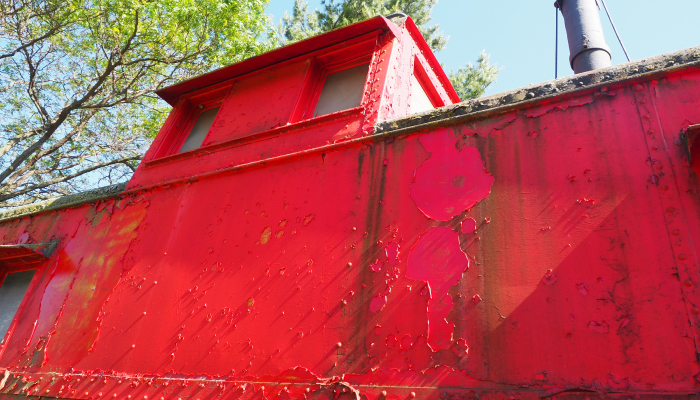
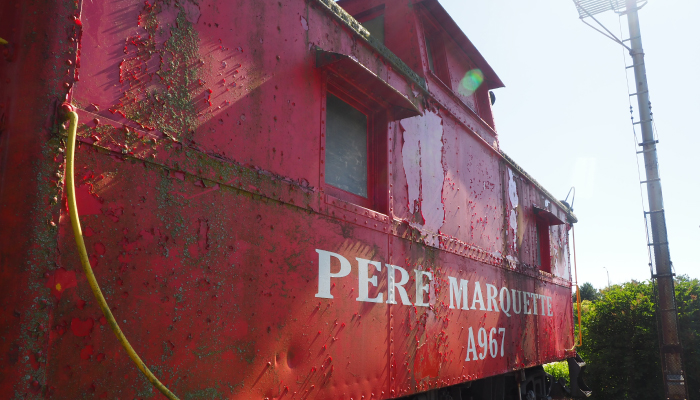
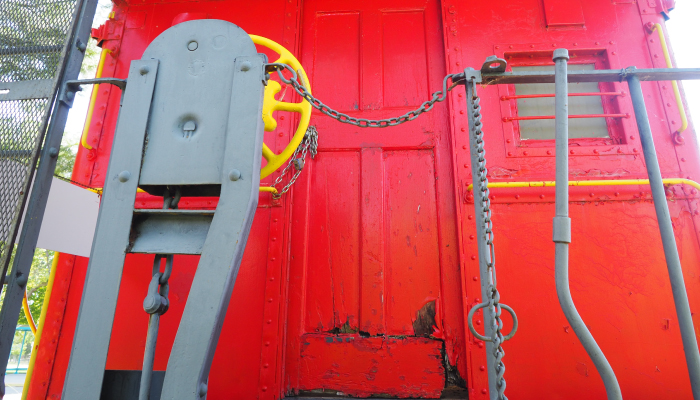


Père Marquette Caboose, No. A967
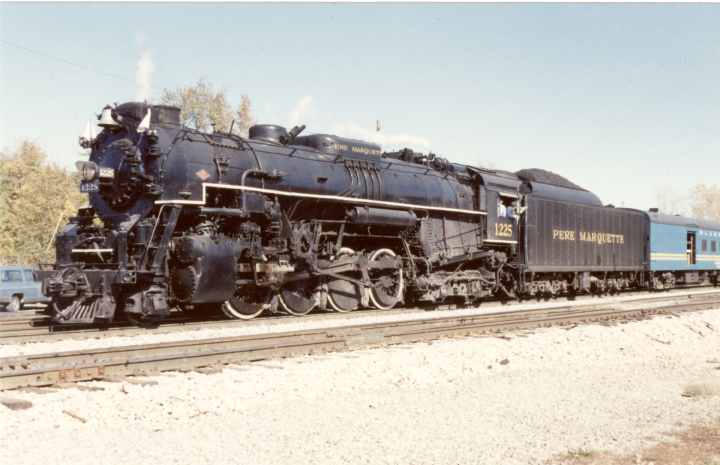
Père Marquette 2-8-4 “Berkshire” Locomotive #1225, Departing Plymouth, MI, October 1990. Photo Courtesy of Fritz Milhaupt
Constructed in 1941, Caboose No. A967 was built by the St. Louis Car Company for the Père Marquette Railway. The “A” stands for “accommodation”. Designed to be the conductor’s headquarters as well as a hub for the crew, a caboose’s interior was outfitted with a table, chairs, beds, icebox, coal stove, sink, and tank for drinking water. This caboose was pulled by a 2-8-4 Berkshire steam engine and was part of a freight line that carried general merchandise.
Cabooses were not necessary on passenger trains as the conductor and other crew members would stay in a passenger car. After the 1980s, a freight train could be run by only two crew members (engineer and conductor), so cabooses were no longer needed.
FAST FACT #2
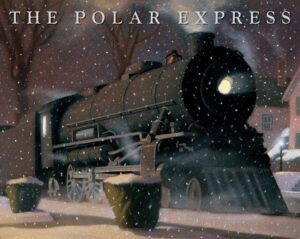 The Père Marquette Locomotive #1225, pictured above, is the model for the train in Chris Van Allsburg's popular holiday book, The Polar Express. Allsburg, who grew up in Michigan, recalls playing on the engine while attending MSU football games with his family. Locomotive #1225 was restored by a group of MSU students after it was decommissioned from the Père Marquette Railway and it now makes annual holiday runs as Michigan’s own “Polar Express.”

Père Marquette Caboose Interior, 1941, St. Louis Car Company. St. Louis Car Company Builder's Photo.
Who Worked on the Père Marquette
In the late 19th and early 20th centuries, there were four types of railroad workers: firemen, engineers, brakemen, and conductors. Firemen and engineers worked as a team. Firemen managed the boiler and firebox to provide the energy necessary for the train to change speed or climb hills. Engineers were responsible for making these calls and ensuring that the train got to its destination safely and on time. They also controlled the main brakes in the locomotive together with the brakemen at both ends of the train. It was typical to have two brakemen on a train: one usually rode upfront in the engine and the other in the caboose. They often performed double duty as flagmen whose job was to flag down oncoming trains if their train was stopped on the tracks. Conductors were the ‘captain’ of the train, who collected tickets on passenger trains and kept track of cars and the materials they carried on freight trains.
Railroads offered steady work, though it was low-paid and incredibly dangerous. For example, African Americans were relegated to the most dangerous positions like brakeman and track laborer, or jobs such as a porter, where they were often overworked and mistreated by passengers and other workers alike. In the late 1800s when the brakeman position became safer, African Americans were pushed out in favor of white men. While railroads were impressive feats of technology and engineering, we must remember that the social and economic prosperity they brought helped a privileged few, while costing the dignity and lives of many.
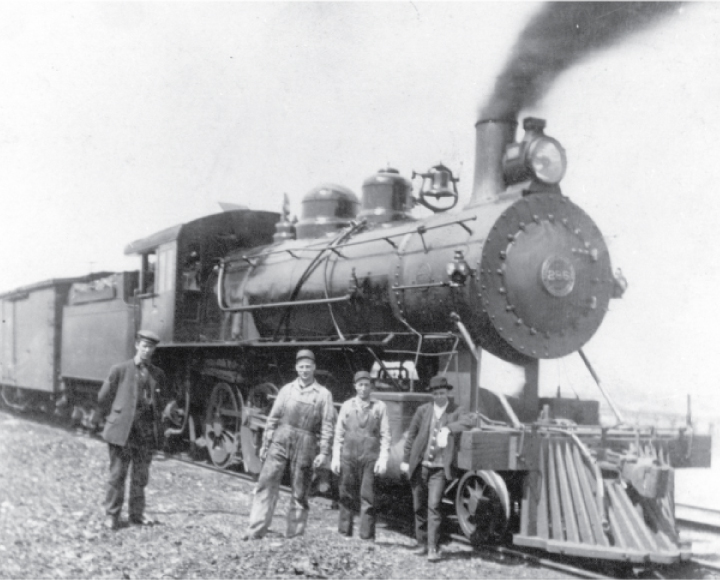
Crew with Père Marquette 2-8-0 #286 in 1905, location unknown. Pere Marquette Historical Society Archives

Female roundhouse worker inspecting the sand dome on a steam locomotive, during World War II. Père Marquette Historical Society Archives
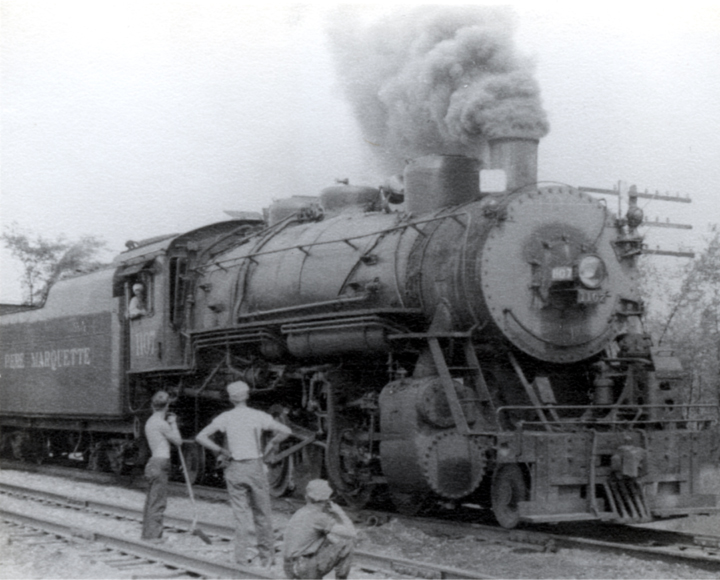
Track gang watches Père Marquette 2-10-2 “Santa Fe” locomotive #1107 leave Waverly Yard, Holland, ca. 1946. Photo Courtesy of Fritz Milhaupt
Holland and the Railway
By 1900 the nation’s railway system was well-established, and with the introduction of rail lines, Holland saw economic growth that was previously unparalleled. Freight railway access made Holland a desirable location to do business, which led companies, such as The Holland Furnace Co., Heinz, and the Bush & Lane Piano Co. to put down roots locally. Similarly, passenger trains allowed for the tourism industry to flourish; from the late 19th century through the 1940s, thousands of vacationers visited Michigan’s west coast via the train.

Père Marquette 2-8-0 “Consolidation” locomotive #909, Waverly Yard, Holland, 1940. Art Million Collection, Père Marquette Historical Society Archives.
The Père Marquette Line
The Père Marquette line was built on land granted by the US government after it was purchased from the Ojibwe, Odawa, and Potawatomi peoples in the 1821 Treaty of Chicago. The railroad was built by Polish, Dutch, Irish, and Mexican immigrants as well as free African Americans. It was consolidated from the Chicago and West Michigan Railway; the Flint and Père Marquette Railroad; and the Detroit, Grand Rapids, and Western Railroad and incorporated in 1899. At that time, it was the largest rail line operating in Michigan with tracks that ran from Chicago, across Michigan through Ontario to Buffalo, New York, including limited lines in Ohio and Indiana.
The line operated freight and passenger service as well as a maritime service, using boats to carry trains, freight, and passengers across Lake Michigan to Wisconsin, and across Lake Erie to Northeast Ohio. The maritime service made the railroad unique, extending their route, thus making the line more competitive. In 1947, the Père Marquette Railway merged with the C&O (Chesapeake & Ohio) Railroad. C&O merged along with several other lines into the CSX railroad in 1987, which is still the train line used in Holland today. The Amtrak passenger train that runs between Grand Rapids and Chicago is named “The Père Marquette."

Père Marquette 4-4-0 “American” steam locomotive #10 with freight cars on the Ottawa Beach Branch, ca. 1908. Père Marquette Historical Society Archives
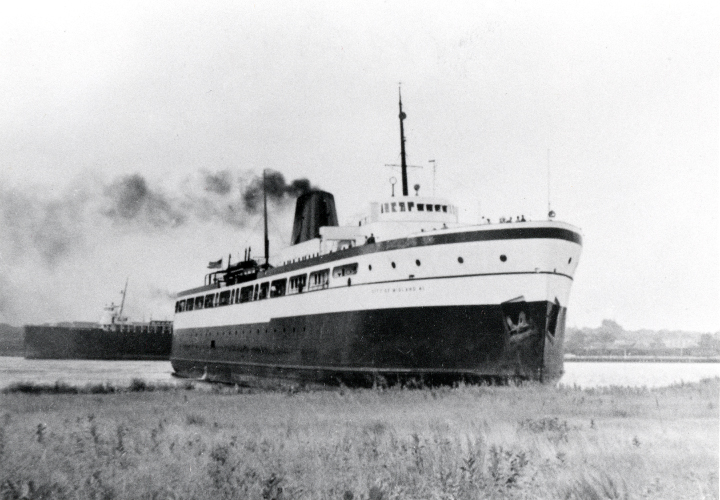
Car Ferry City of Midland 41 arriving in Ludington, ca. 1945. Art Million Collection, Père Marquette Historical Society Archives

Père Marquette Route Map
Donors
The Hemingway Family
In memory of John R. Milhaupt, by his children

Dorothy Sherburne
Clare Heyboer
Bob Berghorst